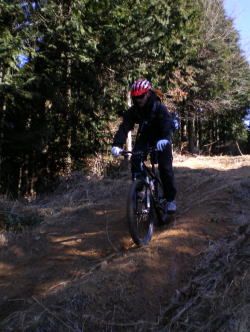
As most of you know, I love cold weather and don’t mind training in it either. Last weekend was great for exercise: Cold and sunny. I ran around 15 miles Friday-Sunday and was invited to play street hockey by some Canadian friends. Two hours of sprinting, making quick cuts and picking fights NHL-style left me SUPER sore for about three days. But it was fun to learn a new sport and will probably join them again.
The weather here in Nagoya has been particularly annoying this week; it feels and looks more like Portland with the constant 40 degree temps and rain. Needless to say, it hasn’t been a good week to take photos. Good news, though, Dave Griser, possibly the friendliest guy in all the land, brought my new point-and-shoot camera in his suitcase. So I will try to get some videos up soon. Anyone have any requests?
Not only is the rain bad for cameras, but it is bad for training, too: Since Monday the rain has completely halted all cardiovascular exercise. “Rain is a poor excuse not to run,” you say…and I agree. However, ya know how Chicago is the “Windy City” and Philly the “City of Brotherly Love?” I think Nagoya should be the “Slickest Sidewalks on the Planet City.” Anyone remember my trips to the chiropractor last year? Chalk that one up to the morons that decided on polished stone footpaths…Needless to say, lesson learned.
Thursday, January 22, 2009

Tuesday, January 13, 2009
Chita Peninsula
So, life as a foreigner (aka “gaijin”) in Japan. I spent last week on-call for work, which meant it was my turn to live in the company-furnished apartment and respond to any needs at the manufacturing facility day or night. One of the benefits of spending the week there, in a city called Taketoyo, is that it is “rural” Japan. (Note their definition of “rural” and mine are completely different. Taketoyo has over 40,000 citizens and is only an extension of the metropolis, about 25 miles from downtown.)
Anyway, Taketoyo is on the Chita Peninsula, southwest of Nagoya. It allows for excellent cardio training on hills and trails, much less traffic, areas to ride my mountain bike, less pollution, great views and plenty of photo opportunities. I took my camera out Sunday afternoon and took some photos. Hopefully you’ll enjoy them!

Citrus Trees: VERY rarely do you see grass yards. Any cultivatable soil is used for fruits, veggies or rice. Fruit—oranges, kumquats, grapefruit—from these trees are being picked right now.

Training Trails: These trails are everywhere.

Most trails are nice though some I’m positive have not had a human on them for months. Stepping in holes hidden in the grass isn't fun. (I have ice on my knee as I type this.)

Farm Ground and Ocean

Shipping: Nagoya has the largest and busiest sea port in Japan, making this area an industrial foundation for the Japanese economy. Toyota Motors and Aichi Steel are headquartered here.

Fishing and Tourism: The waters off of the southern tip of the Chita Peninsula are supposedly excellent fishing for squid…or is it octopus? Either way, in a culture where fish is a daily staple, the fishing industry is very important and thriving here. There rough coastline also attracts many tourists. The average age is at least 60. Not sure what that’s all about.

Shinto Shrine: Shintoism is a religion “conceived” in Japan. It is most closely related to Buddhism, but is uniquely Japanese. Whenever you see a “torii,” think Shinto. (Photo courtesy of Wikipedia.org)
 Isukushima Shring: Perhaps Shinto’s most famous icon—possibly Japan’s most recognizable landmark?—is the Isukushima Shrine near Hiroshima. It’s photo is usually published with part of it underwater, but that only happens at high tide. Apparently it dates back more than 900 years!
Anyway, Taketoyo is on the Chita Peninsula, southwest of Nagoya. It allows for excellent cardio training on hills and trails, much less traffic, areas to ride my mountain bike, less pollution, great views and plenty of photo opportunities. I took my camera out Sunday afternoon and took some photos. Hopefully you’ll enjoy them!

Citrus Trees: VERY rarely do you see grass yards. Any cultivatable soil is used for fruits, veggies or rice. Fruit—oranges, kumquats, grapefruit—from these trees are being picked right now.

Training Trails: These trails are everywhere.

Most trails are nice though some I’m positive have not had a human on them for months. Stepping in holes hidden in the grass isn't fun. (I have ice on my knee as I type this.)

Farm Ground and Ocean

Shipping: Nagoya has the largest and busiest sea port in Japan, making this area an industrial foundation for the Japanese economy. Toyota Motors and Aichi Steel are headquartered here.

Fishing and Tourism: The waters off of the southern tip of the Chita Peninsula are supposedly excellent fishing for squid…or is it octopus? Either way, in a culture where fish is a daily staple, the fishing industry is very important and thriving here. There rough coastline also attracts many tourists. The average age is at least 60. Not sure what that’s all about.

Shinto Shrine: Shintoism is a religion “conceived” in Japan. It is most closely related to Buddhism, but is uniquely Japanese. Whenever you see a “torii,” think Shinto. (Photo courtesy of Wikipedia.org)
 Isukushima Shring: Perhaps Shinto’s most famous icon—possibly Japan’s most recognizable landmark?—is the Isukushima Shrine near Hiroshima. It’s photo is usually published with part of it underwater, but that only happens at high tide. Apparently it dates back more than 900 years!
Thursday, January 8, 2009
Thank you everyone for checkin’ out the blog and for posting your supportive comments. I like Linda’s idea for requests, so if you have any or have a suggestion, then feel free to post it. Note I can’t promise photos of a real yeti, but I will have a new camera to take photos and video sometime in the next couple of weeks. ALSO, make sure to click on the “Follow This Blog” link on the right side of the page.
Since I received a numerous emails and comments about Everest, how about some info you may or may not know:
Everest is one of those wonders of nature that we all seem to be drawn to for whatever reason. I am drawn to it due to my inexplicable infatuation with mountains. A famous, four-line poem by Chinese writer Li Po pretty much sums it up:
All the birds have flown up and gone;A lonely cloud floats leisurely by.We never tire of looking at each other -Only the mountain and I.
Anyway, Mt. Everest sits in the Khumbu region of the Himalaya Mountains. Located along the border between Nepal and Tibet, Mt. Everest is just over 29,029 feet (8,488 meters) high. (Okay, Okay! Technically, the border between Nepal and China. But let’s not quibble…or riot in the streets of Paris and San Fran for that matter.) Known also as Chomolungma, it was first surveyed as a part of the British Survey General of India in 1865 and declared to be 29,002 feet high. (They actually added the 2 so it didn’t seem fabricated. Pretty close to today’s satellite measurements, though!) It was first ascended and descend safely by New Zealand’s Sir Edmond Hillary and his Sherpa partner Tenzing Norgay in 1953 after 31 years of attempts.
Here are a few other tidbits:
· The first two men to ascend without oxygen did so in 1978.
· One of these two men was the first to ascend alone (i.e. no Sherpa or other person helping carry gear, etc.)
· A French pilot did a “hover landing” on the summit in 2005.
· The Nepalese government charges up to $25,000 per person to attempt a summit…not sure how much they charge to ship your frozen body home.
· The two youngest people to summit are women: A 15 year old Nepalese girl and an 18 year old Californian.
· The oldest person up and down: 76 year old Min Bahadur Sherchan.
· Limestone is common on the mountain, including the summit. (If you remember your geology, then you remember limestone is made of slits, clays and millions of marine shells, exoskeletons, etc. In other words, the summit was once on the bottom of the ocean floor.)
· Birds such as the spare-headed goose fly over the summit during migrations.
· By the end of 2007, 2,436 people had summitted and returned alive.
· 210 people have died (just under a 10% death rate for each person that has summited…not even close to Annapurna’s 54% death rate!)
· The highest marathon in the world starts at Everest Base Camp. Anyone up for trying it with me next year?
Something else I think is important to note: I am NOT attempting to climb Mt. Everest. I neither have the money ($60,000-80,000), time (3 months minimum) nor experience to “give-it-a-go,” as my English friend would say. My goal: See the dang thing up close and personal.
This got a little long today and didn’t leave much time for anything else. SO, expect some Japanese flavor in the post this weekend. In the mean time, have a great rest of the week!
Since I received a numerous emails and comments about Everest, how about some info you may or may not know:
Everest is one of those wonders of nature that we all seem to be drawn to for whatever reason. I am drawn to it due to my inexplicable infatuation with mountains. A famous, four-line poem by Chinese writer Li Po pretty much sums it up:
All the birds have flown up and gone;A lonely cloud floats leisurely by.We never tire of looking at each other -Only the mountain and I.
Anyway, Mt. Everest sits in the Khumbu region of the Himalaya Mountains. Located along the border between Nepal and Tibet, Mt. Everest is just over 29,029 feet (8,488 meters) high. (Okay, Okay! Technically, the border between Nepal and China. But let’s not quibble…or riot in the streets of Paris and San Fran for that matter.) Known also as Chomolungma, it was first surveyed as a part of the British Survey General of India in 1865 and declared to be 29,002 feet high. (They actually added the 2 so it didn’t seem fabricated. Pretty close to today’s satellite measurements, though!) It was first ascended and descend safely by New Zealand’s Sir Edmond Hillary and his Sherpa partner Tenzing Norgay in 1953 after 31 years of attempts.
Here are a few other tidbits:
· The first two men to ascend without oxygen did so in 1978.
· One of these two men was the first to ascend alone (i.e. no Sherpa or other person helping carry gear, etc.)
· A French pilot did a “hover landing” on the summit in 2005.
· The Nepalese government charges up to $25,000 per person to attempt a summit…not sure how much they charge to ship your frozen body home.
· The two youngest people to summit are women: A 15 year old Nepalese girl and an 18 year old Californian.
· The oldest person up and down: 76 year old Min Bahadur Sherchan.
· Limestone is common on the mountain, including the summit. (If you remember your geology, then you remember limestone is made of slits, clays and millions of marine shells, exoskeletons, etc. In other words, the summit was once on the bottom of the ocean floor.)
· Birds such as the spare-headed goose fly over the summit during migrations.
· By the end of 2007, 2,436 people had summitted and returned alive.
· 210 people have died (just under a 10% death rate for each person that has summited…not even close to Annapurna’s 54% death rate!)
· The highest marathon in the world starts at Everest Base Camp. Anyone up for trying it with me next year?
Something else I think is important to note: I am NOT attempting to climb Mt. Everest. I neither have the money ($60,000-80,000), time (3 months minimum) nor experience to “give-it-a-go,” as my English friend would say. My goal: See the dang thing up close and personal.
This got a little long today and didn’t leave much time for anything else. SO, expect some Japanese flavor in the post this weekend. In the mean time, have a great rest of the week!
Saturday, January 3, 2009
Am I seriously starting a blog? We’ll see how long it lasts or if any of you come back. Here’s the deal: I’ve decided to take a multi-week trip to mainland Asia and the Himalayan Mountain Range and want you live the next few months of training and trek vicariously.
Hopefully this will be interactive as well as informative. I promise it will not be just about me; if that were my objective, then you’d get a call, email or facebook post you. The purpose of this blog is to give you an opportunity to live and enjoy a culture that likely was completely unattached to yours or your ancestors until World War II. I want to offer you the opportunity to see Japan, meet its people, enjoy its culture and arts and, especially, sit back like other Westerners and wonder, “What the heck are they thinking?” Of course I will also share my outside-Japan experience, too, complete with a basic, real-time Cybercast during the actual trek in Nepal.
This blog—an online diary; a personal chronological log of thoughts published on a Web page, for my elder family members reading—will assuredly contain plenty of photos, links, GPS coordinates, formal names lost in translation, cultural misunderstands, grammatical mistakes, inside jokes, quirky comments, political incorrectness, detailed information among other things. This is for your entertainment and curiosity and for me a digital record that will allow me to relive the “good ole days” as I top 100 years old.
I won’t promise additions or updates at any specific frequency, but hopefully at least a couple times weekly. My blogging experience is probably the same or less than yours: Absolutely nil. Maybe it's is a tradecraft one can learn along the way.
SO, bookmark this page, create a weekly reminder in Outlook to check it for updates and teach those family members that need the lesson to turn on the computer. This should be fun.
Grant
PS Happy New Year!
Hopefully this will be interactive as well as informative. I promise it will not be just about me; if that were my objective, then you’d get a call, email or facebook post you. The purpose of this blog is to give you an opportunity to live and enjoy a culture that likely was completely unattached to yours or your ancestors until World War II. I want to offer you the opportunity to see Japan, meet its people, enjoy its culture and arts and, especially, sit back like other Westerners and wonder, “What the heck are they thinking?” Of course I will also share my outside-Japan experience, too, complete with a basic, real-time Cybercast during the actual trek in Nepal.
This blog—an online diary; a personal chronological log of thoughts published on a Web page, for my elder family members reading—will assuredly contain plenty of photos, links, GPS coordinates, formal names lost in translation, cultural misunderstands, grammatical mistakes, inside jokes, quirky comments, political incorrectness, detailed information among other things. This is for your entertainment and curiosity and for me a digital record that will allow me to relive the “good ole days” as I top 100 years old.
I won’t promise additions or updates at any specific frequency, but hopefully at least a couple times weekly. My blogging experience is probably the same or less than yours: Absolutely nil. Maybe it's is a tradecraft one can learn along the way.
SO, bookmark this page, create a weekly reminder in Outlook to check it for updates and teach those family members that need the lesson to turn on the computer. This should be fun.
Grant
PS Happy New Year!

Stumbling While Photographing Myself at 10,000 ft, Temps Below Zero and Winds Around 50mph on Mt. Houkendake, Nagano Prefecture, Japan.
Subscribe to:
Posts (Atom)